郑州大学女神教官
From joint ventures to joint innovation: Why global autos look to China_我的网站

一 |
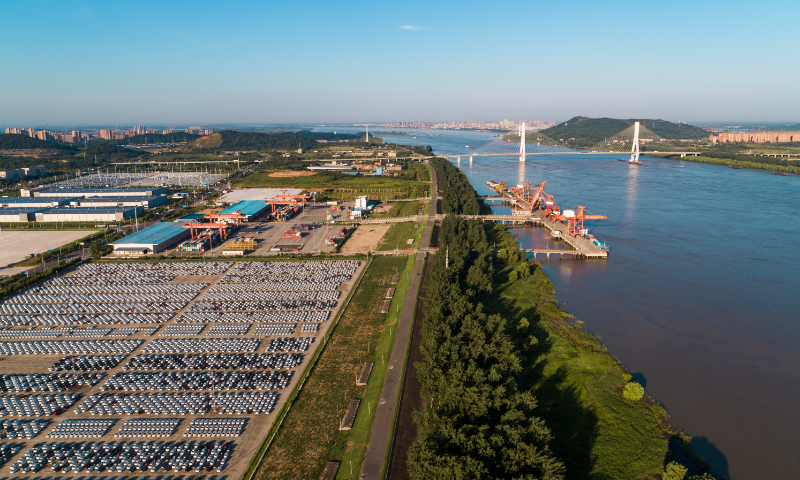
Newly produced vehicles fill a parking lot at a SAIC-GM industrial park in Wuhan, Central China's Hubei Province on July 10, 2022. Photo: VCG
Global automakers are forging deeper and longer-term ties with China, as the country's role evolves beyond a key market into an increasingly important hub for automotive research and development (R&D) and innovation.
SAIC Motor and General Motors (GM) signed an agreement on Wednesday to extend their joint venture partnership by 20 years to 2047. A month earlier, Honda Motor and GAC Group signed a strategic agreement to renew their joint venture (JV) partnership in GAC Honda, extending their cooperation to 2038 while keeping the existing equity structure unchanged.
The renewed commitments to China by global auto giants signal more than confidence in the long-term potential of the Chinese market. It reflects China's evolving role in the global auto industry, from a manufacturing base and sales market to an increasingly important source of innovation and technologies that shapes the future of mobility, Peng Bo, a research fellow at the Chinese Academy of International Trade and Economic Cooperation under the Ministry of Commerce, told the Global Times on Sunday.
Behind this shift is the rapid rise of new-energy vehicles (NEVs) and vehicle intelligence, as global competition increasingly centers on batteries, electric powertrains, intelligent driving, automation, software ecosystems and artificial intelligence (AI), Peng said.
From market to innovationChinese automakers have accelerated their expansion into global markets. According to the latest data from the China Association of Automobile Manufacturers, China exported 5.096 million vehicles in the first half of the year, up 65.3 percent year-on-year, including 2.355 million NEVs, up 120 percent. In just a few decades, China's auto industry has evolved from learning from and introducing advanced foreign technologies into a major global force in automobile production, exports and innovation.
Such a picture would have been almost unimaginable several decades ago. At the time, China's auto industry was still in its early stages and lagged considerably behind global leaders.
In the 1980s, China began integrating into the global auto industry through the establishment of joint ventures. In 1984, Beijing Jeep, China's first Sino-foreign joint venture automaker, began operations, while Chinese and German partners signed the agreement for Shanghai Volkswagen. More global automakers from countries such as Germany, the US, Japan and France followed, bringing capital, technology, equipment and management expertise that helped accelerate China's auto industry development.
From annual auto production and sales of just over 1 million units in the mid-1990s, China saw the corresponding figures surpass 30 million units in 2025, ranking first globally for the 17th consecutive year. Auto exports also surged from just several thousand units to a record 7.098 million in 2025.
These figures illustrate the profound transformation of China's auto industry, which has evolved from a latecomer learning from global peers to a major manufacturing powerhouse and increasingly a source of innovation for the global auto industry, experts said.
Chinese experts attributed China's auto rise to its increasingly strong innovation capabilities. Sun Xiaohong, former secretary-general of the automotive branch of the China Chamber of Commerce for Import and Export of Machinery and Electronic Products, told the Global Times on Sunday that the close integration of R&D, manufacturing and market application has enabled new technologies to move rapidly from laboratories to mass production, while intense market competition has further accelerated innovation and product iteration.
Latest figures tell the story. China has led the world in automobile patent publications over the past decade, far ahead of the US, Japan and European countries. Patent publications in the NEV sector increased from more than 50,000 in 2016 to over 110,000 in 2025, with an annual growth rate of 17.1 percent. Intelligent connected vehicle patent publications rose from 44,000 to 93,000 over the same period, averaging annual growth of 11.6 percent.
In addition to the R&D capabilities, China's complete and highly efficient supply chain strengthens its industrial edge. The International Energy Agency estimates that battery electric car production costs are over 30 percent lower in China than in advanced economies, mainly attributed to lower battery cost and supply chain.
China's technology company Xiaomi only launched its first EV in 2024, but has quickly emerged as a major player in China's NEV market. Its strategy connects cars with smartphones, apps and smart home devices is creating a more integrated ecosystem. At Xiaomi's EV factory on the outskirts of Beijing, a new car rolls off the production line every 76 seconds on average.
Chinese automaker NIO's Hefei factory is known for its highly intelligent and automated manufacturing, using more than 700 robots and achieving an overall automation rate of 97.5 percent.
BYD's EVs can add 20 kilometers of range in just 10 seconds of charging and up to 400 kilometers in five minutes.
"These examples reflect a broader shift in China's auto industry, where strengths in advanced manufacturing, supply chains, software, AI and rapid technology commercialization are increasingly translating into a competitive edge," said Sun.
Cooperation not competitionThe rapid transformation of China's auto industry has put growing pressure on some global auto giants. Honda CEO and President Toshihiro Mibe reportedly said after visiting an auto supplier factory in Shanghai, "We have no chance against this," Nikkei Asia reports.
Ola Kallenius, chairman of the board of management of Mercedes-Benz Group AG, told Chinese media that "In the world's most dynamic automotive market, you have to be here, and we're doubling down on China," People's Daily reported.
"Many major global automakers remain constrained by their long-standing reliance on traditional gasoline vehicles... Although they are pushing ahead with electrification, established technology systems, production networks and traditional development models have slowed," Jia Xinguang, an auto industry analyst, told the Global Times.
By contrast, China's auto industry has made a broad shift toward new technologies, building strengths across the industrial chain and establishing a mature and increasingly self-reliant core technology system, Jia said.
Against this backdrop, foreign automakers' approach to cooperation with China is changing.
Toyota's evolving China strategy provides a telling example. At the 2026 Beijing auto show, Toyota unveiled its "with China, for China" localization strategy, giving Chinese teams a greater role in management, R&D and product development, the Global Times learned from the Japanese company.
Toyota has expanded its China chief engineer team from four to seven, covering gasoline, hybrid and EVs across different segments. It is also empowering local management and deepening co-creation with Chinese partners to make development faster, according to the company.
A similar shift can be seen at Tesla, whose Shanghai Gigafactory is not only a major global production base, but also a key part of its global supply chain and product development. In the first half of 2026, the factory delivered nearly 468,000 vehicles, up 28.4 percent year-on-year. The Model Y L, led by Tesla's China team in design and development and manufactured in China, is also being rolled out in markets including the US, UAE, South Korea, Japan, Singapore and Australia, according to a press release that the company shared with the Global Times on Friday.
Foreign auto parts suppliers are also stepping up innovation in China. Bosch plans to invest more than 2.5 billion euros in AI development by the end of 2027, with much of its automotive-related AI work focused on China and Europe, the Xinhua News Agency reported.
Amid mounting challenges, China-foreign auto joint ventures are taking a long-term approach and actively reshaping their product strategies, R&D models and cooperation frameworks, Xinhua reported, citing Bi Wenquan, an executive vice president of FAW Toyota Motor Co.
These developments point to a broader shift: China's role for global automakers is expanding from "Made in China" to "R&D in China" and "innovation in China," making win-win cooperation increasingly important, said Sun.
For global automakers seeking to stay competitive in the next wave of industry transformation, turning competition into greater opportunities for cooperation with Chinese companies is increasingly becoming an "imperative" rather than an "option," said Sun.
As John Roth, GM senior vice president and president of GM China, said the renewed partnership "reflects the shared confidence of GM and SAIC in SAIC-GM and its long-term growth potential."
"It is not only about continuing what we have built together. More importantly, it is about building a more competitive, resilient, and sustainable business for the future," Roth said.
。 充电器支持PD2.0快充,具备5V,12V,15V电压档位,同时自带有电源输入线和USB-C输出线,方便用户使用。产品已经通过了多个国家或地区的认证,全球各个地区都能使用,可见惠普笔记本电脑在全世界都是相当受欢迎的。下面我们就对这款充电器进行拆解,看看其做工用料如何。

二 | 惠普45W电源适配器外观惠普这款45W电源适配器自带输入电源线以及USB-C输出线缆,不可分离设计,连接处做了抗弯折保护处理。

三 |
电源线采用三脚插头,来自Longwell良维,规格为10A 250V~,通过了CCC认证。
适配器机身方块扁平造型,采用PC阻燃材质黑色外壳,表面磨砂抗指纹。
机身顶面中心设计有HP品牌logo,右侧贴有Windows标签。
机身一侧印有适配器参数型号:TPN-CA02输入:100-240V~50/60Hz 1.4A输出:5V2A、12V3A、15V3A适配器已经通过了KC认证,由群光电能制造。

四 |
机身另一侧还有适配器其它认证信息,通过了GS、CE、EAC、CCC、PSE、UL、NOM、NYCE等多个认证,全球绝大多数国家和地区都能使用。
机身与线缆连接处做了抗弯折保护。
USB-C端子采用弯头设计,方便在狭窄角落使用,线头扁平外壳上设计有HP品牌。
测得电源线长度约为49cm。

五 |
测得机身长度为66.26mm。

六 |
宽度为66.33mm。
厚度为28.9mm。
测得USB-C输出线缆长度约为1.8米,可见适配器整体相当长,满足绝大多场景使用需求。
适配器机身放在手上的大小直观感受。
最后测得适配器总重量约为272g。
使用ChargerLAB POWER-Z KM002C测得适配器支持PD2.0、Samsung 5V2A充电协议。
并且具备5V3A、12V3A、15V3A三组固定电压档位。惠普45W电源适配器拆解对惠普这款45W电源适配器外观和输出进行了解后,下面就进行拆解,看看内部的用料和做工。
沿外壳接缝拆开充电器外壳,内部PCBA模块采用黑色麦拉片绝缘,采用铝制散热片散热。
在拆解中发现电源线采用梅花插头连接。
适配器交流输入采用导线焊接连接。
输出端导线也采用焊接连接。导线冷压端子焊接,并外套热缩管绝缘。
PCBA模块正反面均包裹麦拉片绝缘。
使用游标卡尺测得PCBA模块长度约为60.38mm。
PCBA模块宽度约为60.69mm。
PCBA模块厚度约为23.97mm。
散热片通过焊接固定在PCB背面。

七 |
取下PCBA外层的散热片,内部元件打胶固定及散热。
其中共模电感,安规X2电容,变压器,初级电解电容等元件均打胶固定。
PCB背面打胶填充,并粘贴黑色胶块支撑。
其中整流桥和初级开关管共用一块T型散热片,开关管通过螺丝固定在散热片上。

八 |
PCBA模块正面一览,右上角为保险丝和输入EMI滤波电路,左侧为高压滤波电容,中间位置为整流桥和开关管,右侧为变压器,在右下角为输出滤波电容。
PCBA模块背面一览,左侧焊接输出协议芯片和VBUS开关管,同步整流控制器,左侧焊接反馈光耦。通过对PCBA模块的观察,惠普这款45W电源适配器采用反激开关电源架构,同步整流,宽电压输出。输出电压由协议芯片通过光耦进行控制,实现宽电压输出。下面我们就从输入端开始了解各个器件。
输入端延时保险丝规格为2.5A 250V。
第一级共模电感采用漆包线和绝缘线绕制。
安规X2电容来自SCC实全电子,规格为0.33μF。
第二级共模电感采用漆包线绕制,打胶固定绝缘板。
整流桥型号KBP206GL,规格为2A 600V。
高压滤波电容来自金山,规格为68μF 400V。
初级主控芯片丝印PCL,采用SOT23-6封装。
初级开关管来自东芝,型号2SK3569,是一颗耐压600V的NMOS,导阻为540mΩ。
一颗4.7μF50V电解电容用于主控芯片供电。
变压器采用胶带严密缠绕绝缘,标签印有CHICONY群光字样。

九 |
蓝色Y电容特写。

十 |
EL1018光耦用于输出电压调节与反馈。
同步整流控制器来自MPS,型号MP6901,是一颗快速关断智能同步整流控制器,支持最高400KHz开关频率,支持CCM,DCM,和准谐振拓扑,支持高侧和低侧应用。
同步整流管来自AOS万代,型号AON6450,是一颗耐压100V的NMOS,导阻12.1mΩ,采用DFN5*6封装。

十一 |
输出滤波电容规格为680μF 25V。
协议芯片采用伟诠WT6630P,支持USB PD 2.0快充协议,内置5V、12V、15V、20V的VBUS,可设置为30W,45瓦,60W三种输出模式。该芯片支持节电模式、过压保护、低压侧输出电流分流监控器。
输出VBUS开关管采用万代AO4447A,PMOS,耐压30V,SOIC-8封装。
全部拆解完毕,来张全家福。充电头网拆解总结惠普这款45W电源适配器采用输入线和输出线一体设计,三插电源线长度为50CM,输出线长度为180CM,自带接地线的设计能够提供有效的接地,避免使用时的触电感觉。适配器支持PD2.0快充,具备5V,12V,15V三档输出电压。充电头网通过拆解了解到,惠普这款电源适配器内部PCBA模块包裹散热片,内部整流桥和MOS管固定散热片并打胶加强散热。内部高压开关管来自东芝,同步整流控制器来自MPS,同步整流管和VBUS开关管来自AOS,协议芯片来自伟诠,高压滤波电容来自金山,低压滤波电容来自辉城,大面积的散热设计,满足笔记本电脑长时间满载需求。
Current article:http://lqyogzd.runtunpaixufenjuduishuang.pics/news/20260826_76714.html
Published on:08:48:39